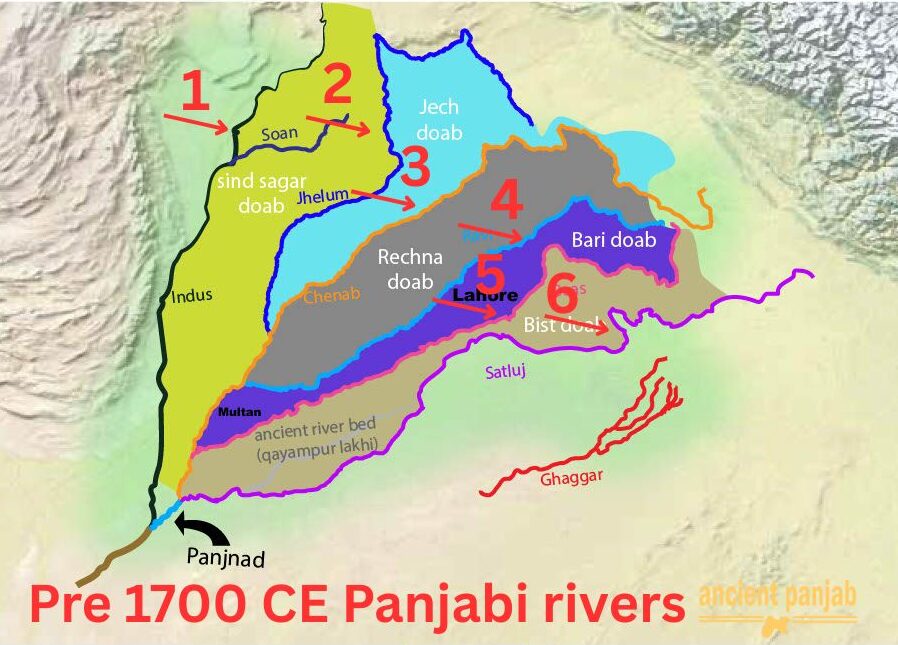
The subject of Sapat Sindhu is such that its description is not found in any written text. Only the term “Sapat Sindhu” itself is known. It was the name of a specific region, but which region was it? Where was it located? No one knows anything about it. Some historians of Panjab identify this region with the area of the Indus River and Panjab, but this identification does not align with the meaning of Sapat Sindhu. In fact, its meaning has also been misunderstood. Sapat Sindhu means “seven rivers,” that is the region where seven rivers flow. but in Sindh region and the Panjab region six major rivers flow through. Our historians have linked the seventh river with either the Ghaggar, the Saraswati, or the Yamuna. But none of these three rivers, in any way, corresponds with the Sindh river basin. Sindh river system itself is a separate region. As an independent entity, it can neither be counted among the five rivers of Panjab nor combined with its western tributaries for counting.
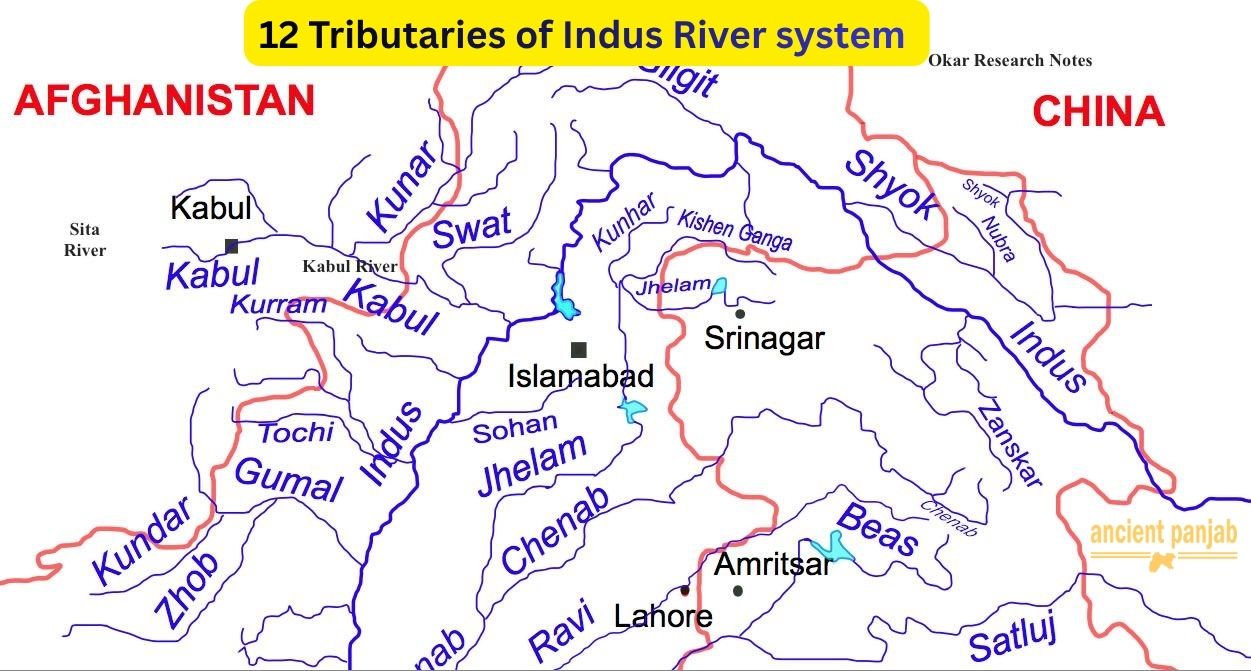
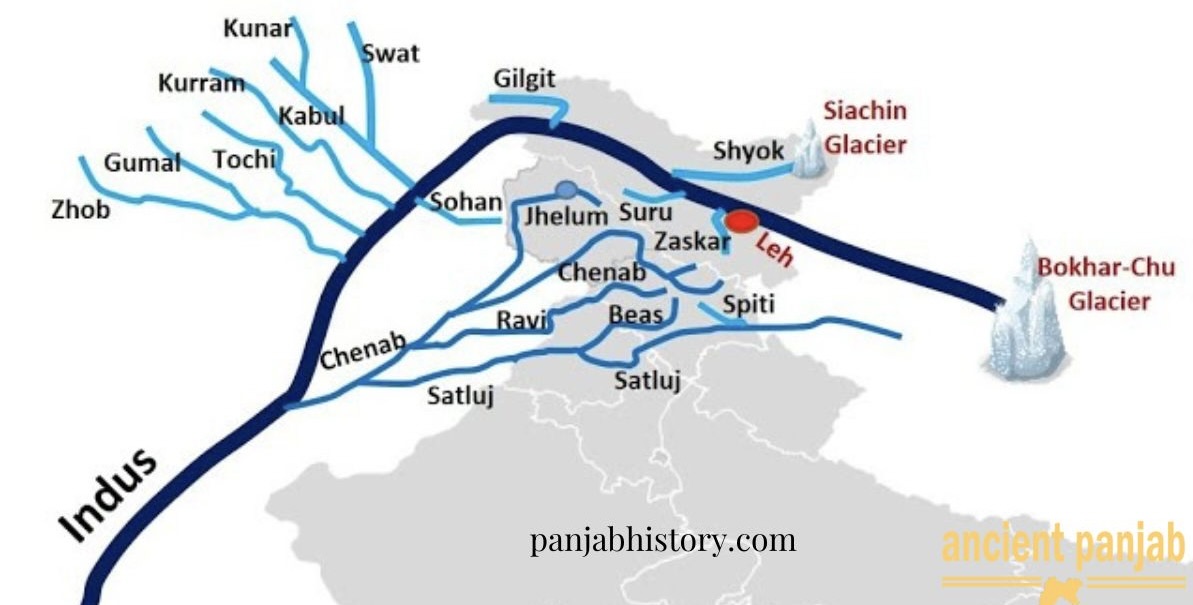
Just as the five rivers of panjab to the east of Sindh are its tributaries. Similarly, to its west, five major rivers flowing through the land of Afghanistan are also its tributaries. Their names are: 1. Kubha, 2. Kurram, 3. Gomati, 4. Rasa, 5. Swat (Swastu). “Tributary” means a river that flows into and joins another river. In this way, Sindh is a vast river with ten tributary rivers. It cannot, in any way, be identified as the land of seven rivers. In this light, the identification of Sapat Sindhu with panjab is merely an assumption. Its real identity lies elsewhere. In fact, our historians have interpreted the word “Sindhu” in Sapat Sindhu as the Sindh River. Because of this interpretation, they understand it to mean the Sindh region of the seven rivers. However, in Sapat Sindhu, the word “Sindhu” simply means water or river. As mentioned earlier, the meaning of “Sindh” is related to water, not specifically to the Sindh River. In this way, misunderstanding the meaning of Sapat Sindhu completely changes its overall sense. This land of seven rivers is some other region beyond panjab and Sindh. However, no one has searched for its true identity. In light of these ideas, the discussion surrounding Sapat Sindhu up to now has become largely imaginary. Historical research is meant to end such speculation and bring the truth to light. This article is an attempt to do exactly that.
The term Sapat Sindhu was first mentioned in the Persian scripture Zend Avesta in the form of “Hapta Hindu” or “Hapta Hendu.” Zend Avesta is a text that predates the Rigveda. It is clear that when a term is first mentioned in a text written in the language of a land outside the Indian subcontinent, there should be no hesitation in accepting that the country bearing this name was
also located somewhere outside the Indian subcontinent. It has already been accepted that the Rigveda and the Zend Avesta share many similarities. Broadly speaking, both the Zend Avesta and the Rigveda reflect the common background of the Aryan people. In the Zend Avesta, the sound represented by the letter “H” appears in the Rigveda as the letter “S.” In this way, the “Hapta Hendu” of the Zend Avesta became the “Sapat Sindhu” of the Rigveda, and the “Harahvati” of the Zend Avesta became the “Saraswati” of the Rigveda.
Just as the name “India” was developed by the Greeks from the Indus River, similarly, by changing the letter “S” to “H” in the word Sindh, the name “Hindustan” came into use. The word “Hindu” was derived from the Zend Avesta. The literal meaning of “Hindustan” is “the Sindh people living in the region of the Sindh River.” These Sindh people gradually came to be known as Hindus.
In fact, the name “Hindustan” was originally given by the Iranians. The people of Iran referred to those living along the Sindh River as Hindus (Sindhus), and they called the coastal region of the Sindh River “Hindustan” (Sindhustan). In this way, the terms “Hindu” and “Hindustan” neither referred to the followers of the Vedic religion nor to the modern nation of India. These names referred only to the region of the Sindh River and the people living there. “Hindu” and “Hindustan” are terms that represent the character of the Indus Valley Civilization. (1)
In this way, just as the word “Hindu” originated from the language and texts of a region outside the Indian subcontinent, similarly, the word “Sapat Sindhu” also originated from the language and texts of a region outside the Indian subcontinent. This fact alone is enough to suggest that if there was a region or country called Sapat Sindhu, it existed somewhere outside the Indian subcontinent. The religion of Zoroastrianism, whose primary sacred text is the Zend Avesta, originated in the region of Azerbaijan. (2) Likewise, Pandit Kshetres Chandra Chattopadhyaya, on the basis of the Rigveda, located Sapat Sindhu in the region of Turkmenistan. Both Azerbaijan and Turkmenistan are regions situated in southern Russia. Before spreading to different parts of the world, this area was considered the homeland of the Aryan people. The Kingfisher History Encyclopedia states that around 3,500 years ago, a group of cattle-herding people crossed the Hindu Kush mountains and reached the land that is now called Pakistan and India.
These were the Aryan people who were fleeing from their original homeland in southern Russia. Some natural disaster, possibly a drought or disease, had forced them to leave the region. From there, they migrated to Anatolia (Turkey), Persia (Iran), and eventually to India.
(About 3400 years ago a band of Pastoralists crossed the mountains of the Hindukush into the lands which are Pakistan and India. They were the Aryans, fleeing from their original homelands in Southern Russia. A natural disaster, possibly drought or disease, made them move. They went to Antolia, Persia and finally to India.) (3)
Although the Zend Avesta, like the Rigveda, was composed over different periods of time, its original and earliest form had already been written before the Rigveda. This is supported by the fact that, before entering the land of India, particularly the Sindh region, the Aryan people had already settled in Persia (Iran). The Aryans who entered India came through Persia. This is also one reason why the Zend Avesta and the Rigveda share many similarities.(4) The Kingfisher History Encyclopedia further states that around four thousand years ago, a great transformation took place east of the Atlantic Ocean. A large group of people known as the Indo-Europeans or Aryans departed from their homeland in southern Russia. Some of these Indo-Europeans moved southward and reached the land that later came to be known as Iran.
(A great change took place east of the Atlantic Ocean around 4,000 years ago. A group of people known as the Indo-Europeans, or Aryans, moved from their homeland in southern Russia. Some Indo-Europeans travelled south into what is now Iran, a name derived from the word ‘Aryan.)
In the light of the above statements, it has been accepted that before entering India, the Aryan people who came here had been living in the land of Iran. During their stay there, the beliefs, customs, traditions, and practices of the Aryan people were compiled in the Zend Avesta. These same traditions and beliefs were later recorded in the Rigveda when it was composed on Indian soil. Thus, the Zend Avesta predates the Rigveda, and the two texts share many similarities.
Now the second part of the article is discussed. In this section, an attempt has been made to explain how the term Sapat Sindhu came to be mentioned in the history of Panjab if it originally referred to a region outside the Indian subcontinent. It is worth noting that even in the history of Panjab, this term only began to appear in writings from the 1930s onward. In writings before that period, there is not even a passing reference to this term. In modern writings, the first mention of this term appears in Bhai Kahn Singh Nabha’s work Mahan Kosh. He writes: “The land between the Ghaggar and the Sindh River, which in ancient texts is referred to as Sapat Sindhu. The five rivers of Panjab, along with the Ghaggar and Sindh.” (5)
As mentioned earlier, Sindh has ten tributary rivers. Out of these ten tributaries, the Sindh River itself cannot, under any circumstances, be separated from the system. It may be possible to treat the five eastern rivers of Panjab and the five western rivers flowing through Afghanistan as separate units, just as the five rivers of Panjab form a distinct regional unit. However, the name Sindh represents the entire coastal river system as a whole. When we speak of Sindh, it includes the entire region watered by the river itself and by all of its tributaries.
The Ghaggar is not a river of the Sindh river system. In fact, the Ghaggar is not truly a river at all, but a seasonal stream formed by rainwater flowing from the regions of Kasauli, Dharampur, Kalka, and Pinjore in Himachal Pradesh and Haryana. It eventually disappears into the sand dunes of Hanumangarh in Rajasthan. It is also incorrect to claim that it was once a great river in ancient times, because from the beginning of the historical period of Panjab, it has only been mentioned as a seasonal stream. In this way, the above statement of Bhai Kahn Singh Nabha is itself incorrect.
What is surprising is that even great and highly respected historians such as Ganda Singh began using this term so irresponsibly that their statements do not stand close to any logical argument or reasoning. Giving an example of this irresponsibility, the scholar writes: “In ancient times, Panjab was known as Sapat Sindhu. Its five rivers, excluding the Sindhu, were the Jhelum, Chenab, Ravi, Beas, and Sutlej. Even after the Partition of 1947, Indian Panjab still remained the land of five rivers. These are the Ravi, Beas, Sutlej, Saraswati, and Yamuna.”(6) The carelessness in this statement becomes evident from the fact that the Ghaggar has been omitted and the Saraswati River has been included instead. At least the Ghaggar still exists in some form today, but the Saraswati has no existence at all. It has disappeared even as a seasonal stream. Secondly, the Yamuna has unnecessarily been included among the rivers of Panjab. The Yamuna is a tributary of the Ganga river system. This irresponsible statement by Ganda Singh distorts the very face of history. Another non-historian, Mahinder Pal Kohli, also attempts to twist historical facts by writing that the geographical boundaries of ancient Panjab were identified through the three words of the Rigvedic Sapat Sindhu.(7)
In fact, the term Sapat Sindhu entered the history of Panjab because of the misunderstanding created by the word “Sindh” within it. Our writers have interpreted this word as referring to the Sindh River. As already explained earlier, here the word “Sindh” simply means a body of water or a river. In this way, our writers misunderstood the meaning of the term and gave the entire subject a wrong direction. Those who identified Sapat Sindhu with the land of Panjab were not only mistaken, but also attempted to distort the history of Panjab.
In the third part of the article, the discussion will focus on how the term Sapat Sindhu has been described in Vedic literature. Undoubtedly, this is a term belonging to Vedic literature, and in order to understand its true meaning, it is necessary to examine the interpretation given within the Vedic texts themselves. In Indian literature, the term Sapat Sindhu was first used in the Rigveda. In the Rigveda, it appears twelve times, particularly in the eighth mandala. The form of the word is not the same everywhere. It appears in different forms such as Sapat Sindhu, Sapat Sindhav, Sapat Sindhur, Sapat Sindho, and Sapat Sindhava, among others. However, the meaning remains essentially the same in all cases. In five places, the term is used to describe the rivers that the Vedic deity Indra liberated after fighting the Vedic demon Vritra. Along with freeing the rivers, Indra also released light and sunshine from the captivity of that demon. The term is used twelve times in the Rigveda, particularly in the eighth mandala. The form of the word is not the same everywhere. It appears in different forms such as Sapat Sindhu, Sapat Sindhav, Sapat Sindhur, Sapat Sindho, and Sapat Sindhava, among others. However, the meaning remains the same in all cases.
In five places, the term is used for those rivers that the Vedic deity Indra liberated after battling the Vedic demon Vritra. Along with freeing the rivers, Indra also released light and sunshine from the demon’s captivity. He continued to drive away darkness from the world. Indra fought against Vritra, defeated him, and by removing the dark clouds, cleared the sky so that sunlight could spread again. With the return of sunlight, the snow melted and the rivers began to flow. In this way, the seven rivers of the Aryan land, known as Sapat Sindhu, started flowing once again.
Two points in the above statement deserve special attention. First, in the land where the Aryan people lived, dark rain clouds were considered harmful. They referred to these clouds as a demon, meaning that they regarded them as an enemy. The task of driving away these clouds was attributed to the god Indra.
If we look at Panjab, the situation is actually the opposite. The appearance of clouds has traditionally been considered a symbol of happiness. People feel joyful when the sky becomes cloudy because it brings relief from the heat, creates coolness, and raises hope for rainfall. In fact, if clouds do not appear for a long time and rain does not fall, people begin to fear famine. They perform rituals, offer prayers, and follow various customs in the hope that clouds will gather soon. The arrival of clouds brings joy not only to humans but even to birds and animals. Peacocks begin to dance, and birds chirp happily. In this way, the beliefs of the people of Panjab stand in contrast to those of the Aryan people described earlier. The Aryans feared dark clouds and constantly wished for the sun to remain shining.
The second point that emerges from the above discussion is that with the appearance of the sun, the snow melts and the rivers begin to flow. This suggests that the homeland of the Aryans must have been a region where heavy snowfall occurred and sunlight was limited. It points toward a cold country where snow covered the land for long periods, causing rivers to freeze and stop flowing. Darkness remained for extended periods of time. People suffered because of the snow and the lack of sunlight. Animals could not find grass or fodder, and crops could not grow. Therefore, people prayed for sunlight to appear quickly and for the harsh conditions to end. When the season changed and sunlight returned, the snow melted, and rainfall also occurred. In this way, the Aryan people expressed the yearly cycle through the belief in the battle between the god Indra and the demon Vritra. According to the writer, this description does not fit Panjab. Panjab has historically been a warm region where snowfall does not occur. Its rivers flow throughout the year, rainfall is limited, and people suffer more from heat than from cold. They pray for relief from heat rather than for sunlight. Thus, the environment described in the Rigveda as Sapat Sindhu is different from the environment of Panjab.
As mentioned earlier, the term Sapat Sindhu appears twelve times in the Rigveda. The meaning discussed above applies to the five occurrences of the term. The remaining references carry a somewhat different meaning. According to these descriptions, the seven rivers of Sapat Sindhu flow only in the sky. They move upward from below, and their movement spreads light as well. They flow in groups of three, and from these groups branch out into seven streams each.
In this way, the account is largely imaginative or mythological in nature. It may be associated with monsoon winds, but not with actual rivers flowing on the earth.
One possible reason for these two different interpretations is that the Rigveda was neither composed at a single point in time nor written by one individual. Rather, it was created over different periods and by different authors. The differing interpretations mentioned above are the result of these different times and contributors. Every age and every writer has their own interpretation. Out of the twelve references to Sapat Sindhu, only one presents it in a geographical sense.
This appears in the eighth mandala of the Rigveda, in verses 24 and 27. These verses, to a considerable extent, provide a historical and geographical explanation of Sapat Sindhu. The verse is as follows:
Towards the seven rivers, to the shelter-giving Hari.
In the land of battle, beautiful in form and arising in the east.
This land lies in the Balakh region, in the middle of Asia.
It is known as Samire Shishag, and there flows the Sapat Sindhu.
In this verse, four words appear with deep significance: first, Balakh Parant; second, Central Asia; third, Somireshishag; and fourth, Sapat Sindhur. The overall meaning is as follows: “We worship the land called Sapat Sindhu. We seek refuge in it as one seeks refuge in the Divine. This land is very beautiful, and we also admire its fertility and richness. This country is situated in the region of Balakh, in the land of Central Asia. It is famous by the name Somireshishag. In other words, it is also called Sapat Sindhu.”
According to this interpretation, the identity of this land becomes clear. Balakh Parant means the land of the Balakh Sea. Balakh Parant is located in the region of Central Asia. It is famous by the name Semire Shishag. Semire Shishag means “seven rivers.” According to this explanation, the land of Panjab cannot fit into this description, because there is no sea called Balakh here, nor is Panjab situated in Central Asia. Panjab has never been known as Sapatshring.
This Balakh Sea is located in the Turkmenistan region of Russia, and thus Sapat Sindhu also corresponds to a region in Central Asia, specifically Turkmenistan. Seven rivers originating from the Hindu Kush mountains flow into the Balakh Sea. These rivers are the Illi, Lepsa, Katal, Barkan, Arju, Sarkan, and Siye. Among these, four rivers — Baskan, Aksu, Sarkan, and Siye — flow only during the summer season. During winter, the region freezes with snow, and the rivers stop flowing.
The idea in the Rigveda of the yearly battle between Indra and Vritra, associated with the rivers of Sapat Sindhu, also fits this region. These four rivers begin to flow only when winter ends and summer begins. The climate of the Balakh Sea region changes very suddenly. In Panjab, seasonal changes take place gradually over months, but there the change can happen within days. Winter turns into summer in just two or three days, and with the arrival of warmth, rainfall also begins. Thus, the description of Indra freeing both water and light from the captivity of the demon Vritra fits this region very closely. On the basis of the conclusions of H. Bernaufer and N. G. Sardesai, Kshetraesh Chandra Chattopadhyaya also concluded that the Semire Shishag (Sapatshring) mentioned in the Rigveda, also known as Sapat Sindhu, was located in the Turkmenistan province of Russia.
Kshetraesh Chandra Chattopadhyaya(8) writes that in the Semire Shishag region, the drying up of rivers before the arrival of the rainy season can easily be understood. It is quite possible that during the period between 3000 and 2200 BCE, an unusual drought occurred, and this prolonged drought forced the Aryan people to leave the region and migrate toward Iran and India. The Balakh region could very well have served as the starting point for the southward and westward migrations of the Aryans. (Consequently, the drying up of rivers before the rains in such a region as Semirechinsk can very easily be understood. It is quite likely that a period of unusual drought, say the one between 3000 and 2200 B.C., led the Aryans or some of them to leave the land and march towards India and perhaps also towards Iran. The Balkash region may easily have been a starting point for the southward and westward marches of the Aryans.”)
Continuing his argument, Kshetraesh Chandra Chattopadhyaya further writes that the mythological battle between Indra and Vritra cannot be applied to any region more satisfactorily than Semire Shishag, nor can it be explained more convincingly elsewhere. In the absence of any more satisfactory interpretation, it becomes quite reasonable to identify the myth of the Indra-Vritra conflict with the land of seven rivers in Russian Turkestan, known as Semire Shishag. According to him, the Aryan people lived in this region for a long period, and it was here that the distinctive features of their character developed. If, according to the view of D. Morgan, Siberia is accepted as the original homeland of the Indo-European people, then before migrating toward Iran and India, Semire Shishag was the land where they had settled.(9) Therefore, we should accept that the number “seven” was a traditional and symbolic number among the Aryan people. The Aryans came from a land where exactly seven rivers flowed. Even after leaving that land centuries earlier, the memory of this “number seven” did not fade from their minds, and it became a permanent part of their cultural memory.
The conclusion, therefore, is that Sapat Sindhu was not the ancient name of Panjab. Rather, it was the name of the land where the Aryan people had lived thousands of years ago. According to this interpretation, that land was located in the Turkmenistan region of Russia. Its name was Semire Shishag, and it was also called Sapat Sindhu. Seven rivers flowed through this land. These rivers originated in the Hindu Kush mountains and emptied into the Balakh Sea. The mythological stories in the Vedic texts about the battles of the god Indra with demons were composed or developed on this very land of Semire Shishag. The Rigveda remains the primary source for this entire discussion.
This discussion has so far been based only on the Rigveda. However, there is other Vedic literature as well, commonly referred to as later Vedic literature. This later Vedic literature includes many texts and Smritis, but only two texts specifically mention Sapat Sindhu. These are the Ramayana and the Mahabharata. The interpretation of Sapat Sindhu given in these texts is completely different from that of the Rigveda.
According to the Ramayana, the seven rivers of the Sapat Sindhu were branches of the Ganga River that emerged from the matted locks of Shiva. The waters of the Ganga, flowing from Shiva’s hair, were divided into seven rivers. Of these, three rivers, Nalini, Hladini, and Pavani, flowed eastward, while three others, Chakshu, Sita, and Sindhu, flowed westward, and one river, named Bhagirathi, flowed southward. Thus, in the Ramayana, Sapat Sindhu is associated with Shiva and with the region of the Ganga river system. It is quite clear that by the time of the Ramayana, the Aryan people had spread throughout India. Shiva, who was not originally a Vedic Aryan deity, had by then been incorporated into the later Vedic tradition as a god. In the later Vedic literature, the entire description belongs to the literary and mythological world of India itself. This interpretation only shows that the region of Sapat Sindhu was not Panjab, but it does not reveal anything about the original identity of Sapat Sindhu itself.
In much the same way, the interpretation of Sapat Sindhu given in the Mahabharata(10) also reflects the expansion of the Aryan people across the Indian subcontinent. In the Mahabharata, Sapat Sindhu is mentioned only in a few places. In one passage, the seven rivers of Sapat Sindhu are listed as: 1. Vashnokarj, 2. Nalini, 3. Pavani, 4. Ganga, 5. Sita, 6. Sindhu, and 7. Jambu River.
In another passage, the names differ somewhat and are given as: 1. Ganga, 2. Yamuna, 3. Plaksasa, 4. Rathastha, 5. Saryu, 6. Gomati, and 7. Gandak. These names are largely similar to those mentioned in the Ramayana. The difference appears mainly in the second list of names. According to the writer, the second list represents the Ganga River system and the Sindh River system together as one combined region.
In fact, the memory and tradition of the seven rivers of Sapat Sindhu were so deeply rooted in the minds of the Aryan people that wherever they settled, they viewed the rivers of that region in terms of the sacred number seven. (It is therefore more natural to hold that all these were ancient mythological names brought with them by the Aryan settlers to their new home and applied to new places or objects.)
The period of the Ramayana and the Mahabharata was the age in which the Aryan people had spread throughout India and established their civilisation. By this time, the Aryans had expanded across the Indian subcontinent and had established their political power. Because of this, when identifying the seven rivers, they would leave out smaller rivers in favour of the major ones. When they first entered the Indian land, they combined the Sindh River with the five rivers of Panjab and added the Saraswati as the seventh river. Later, when their expansion reached the Yamuna region, they included the Yamuna and, in the same manner, omitted one or two of the rivers of Panjab. As their expansion moved from the Ganga region toward the south, rivers such as the Kaveri and the Narmada also became part of their group of seven rivers. Thus, although India has countless rivers, the Aryan people continued in their writings to refer symbolically to only seven rivers.
Bal Gangadhar Tilak described the sacred importance of the number seven in the minds of the Aryan people in the following way. He writes that in the scriptures of both the Iranians and the Aryans, the significance of the number seven had existed since ancient times as a continuing tradition. Whatever the original reason may have been, the number remained deeply symbolic. Thus, their texts commonly refer to seven continents, seven mountains, seven directions, seven seas, the seven horses of the sun, seven rays, and seven sages. Tilak argues that the seven rivers of the Sapat Sindhu should also be understood in this symbolic and traditional sense.(12)
Even in the Rigveda, where the term Sapat Sindhu appears repeatedly, the names of fifteen tributaries of the Sindh River are mentioned. These include the ten tributaries of the Sindh River, among them Kubha and Karmu, along with five additional rivers. Among these five are the Ganga, Yamuna, eastern Saraswati, Ghaggar, and Apaya.
The conclusion drawn from all this is that neither these rivers nor the Sapat Sindhu described in Vedic literature had any connection with Panjab.
It is also important to note that the geographical position of Panjab is such that the Saraswati River cannot properly be connected with it. The Ganga and Yamuna are even more clearly unrelated because their river systems are entirely separate from that of the Panjab. Panjab belongs to the basin of the Sindh River, whereas the Saraswati is associated with the Ganga-Yamuna river system. Similarly, the geographical structure of the Sindh River itself makes the idea of only seven rivers incorrect. On both the western and eastern sides of the Sindh River, there are ten tributaries in total. On the western side are the rivers Kubha, Karmu, Gomati, Rasa, and Swat (Swastu), while on the eastern side are the Jhelum, Chenab, Ravi, Beas, and Sutlej. Therefore, the idea of Sindh having only seven branches becomes incorrect in itself. If the tributary rivers of the Sindh are to be counted along with it, then the total becomes eleven rivers, including its ten tributaries. The point simply is that the concept of Sapat Sindhu cannot be fully explained merely by adding six more rivers to the Sindh River.
Apart from the interpretation of the concept of Sapat Sindhu found in later Vedic literature, several other descriptions in the same body of literature suggest that the land called Sapat Sindhu was not Panjab, but some other region. These details appear in statements within Vedic literature concerning Panjab, its land, and its people. There is no doubt that many such references exist in Vedic texts. First, we may examine the statement in the Rigveda that describes the battle of the ten wise kings. In order to resist the Aryan people, the inhabitants of Panjab united and formed a confederation. This alliance consisted of ten kings. The existence of such a confederation clearly suggests that these rulers belonged to the region of Panjab itself. Even if some were smaller kingdoms, the number still came to ten. In the form of these ten kings, the whole of Panjab rose together against the invaders. In the Rigveda, all the inhabitants of Panjab are referred to as Dasas (Dasus). This term itself reflects the hostility of the Aryan people toward the people of Panjab. The Aryans considered themselves highly wise and civilized, while viewing the inhabitants of Panjab as servants or demons. To challenge this hostile attitude of the Aryans toward the people of Panjab, it is enough to note that the people of the Indus Valley Civilisation, which included Panjab, have been regarded by historians as highly prosperous and urbanised.(13). There can be no two opinions about this. Referring to the prosperous and urbanized people of the Indus Valley Civilization, which included Panjab, as Dasas, demons, speakers of a corrupt language, or uncivilized people in Aryan texts is itself a deeply flawed notion. According to the writer, this idea also suggests that if Panjab had truly been known as Sapat Sindhu, the Aryan people would never have described the inhabitants of their own land in such derogatory terms.
Ramdhari Singh Dinkar, after making a comparative study of Sapat Sindhu and the Indus Valley Civilization, concluded that Sapat Sindhu could not possibly have been located in the region of the Indus Valley Civilization. According to him, Sapat Sindhu was the original homeland of the Aryan people, whereas the Indus Valley Civilization, which Dinkar refers to as the civilization of Mohenjo-daro, was a culture distinct from that of the Aryans. The strongest evidence for this, according to him, is that the worship of Shiva was prevalent in the Mohenjo-daro civilization, while among the Aryans this form of worship became accepted much later, and even then against the wishes of the Vedic sages.(14)
The struggle of the people of Panjab in the confederation of the ten kings was a battle to preserve their existence against the Aryan invaders. According to the Rigveda, this battle extended from the Ravi region to the area of the Saraswati. That is, this great war spread across the vast region extending from the Ravi to the Saraswati. In other words, almost the whole of Panjab may have been involved in this conflict. According to the Rigveda, after achieving victory in this battle, the five Aryan tribes, under the leadership of Sudas, advanced as far as the Saraswati region. Sudas was the chief of the Bharat tribe.(15). On the banks of the Saraswati, the two princes of Sudas worshipped the fire god Agni and celebrated their victory. Among the five Aryan tribes involved in the conflict, the Bharat tribe was the largest and most influential. Sudas himself belonged to this tribe. This account makes it clear that although the Aryan tribes defeated the people of Panjab, they did not settle in the Panjab region itself. Instead, they came and settled on the banks of the Saraswati. This suggests that the Aryan tribes settled around the Saraswati region rather than in Panjab. It is also important to note that in later Vedic literature, the Saraswati is regarded as the boundary between Panjab and the Ganga-Yamuna region. Although the Kurukshetra war described in the Mahabharata may have been written in various ways, it essentially presents Panjab and the Ganga-Yamuna region as two separate areas. According to the writer, the reason the battle took place at Kurukshetra lies in an old belief deeply rooted in the minds of Aryan scholars, a belief that portrayed Panjab and the Saraswati-Ganga-Yamuna region as opposing regions. The boundary between the two was shown as Kurukshetra, associated with the Saraswati. Traditionally, the Saraswati has long been regarded as the dividing line between the land of Panjab and the Ganga-Yamuna region. Buddh Prakash supports this interpretation by stating that the dry Bangar region of present-day Kurukshetra, extending toward Rajputana, forms the dividing line between the plains of the Sutlej and the Yamuna. (At present the dry up land Bangar of Kurukshetra leading into the desert of Rajputana, acts as the dividing line between the alluvial plain, Khadar of the Sutlej and Yamuna.)(16)
In the 44th chapter of the Mahabharata, in the Karna Parva, it is written that one should not go to the land of Vahika (Panjab), where five rivers and the sixth, the Sindhu, flow. According to the text, this land is not purified by the Himalayas, the Ganga, the Yamuna, or the Saraswati, and it is said to be devoid of true religion and purity. It further describes the people there as those who eat beef with garlic and drink liquor made from rice extract, portraying them as outside the qualities of noble families. The text states that this land was called Aront, the land of the Jatts, and was considered devoid of religion. It warns people not to go there. It further says that if one drinks the water of Yugandhar (Jalandhar), stays in Achyut Sthal, or bathes in the lake of Bhutalav, how could such a person attain heaven? It also declares that an Aryan should not stay for even two days in the land of Aratt or Vahika, where a Brahmin becomes a Kshatriya and no longer remains truly Brahmin.(17) Muhammad Latif writes that the verses of the Rigveda are clear evidence that the early Aryan people were not allowed to settle in Panjab without conflict and struggle.They had to fight long and fierce battles against the warrior Rakshasas, Asuras, and dark-complexioned giants of Panjab.(18) James Edgar writes that the Vedic poets speak of a dark-skinned race that attempted to resist the arrival of the Aryan people around 1200 BCE. There are also descriptions of Aryan invasions and of conflicts among related groups who belonged to the same cultural family as the Indo-European peoples.(19)
In conclusion, it may be said that Sapat Sindhu is a term deeply connected with the emotions and traditions of the Aryan people. Its original origin can be traced to the Persian scripture Zend Avesta. The Zend Avesta and the Rigveda resemble each other in many respects. This suggests that the Persians and the Aryan people shared a common background. The descriptions given in Aryan texts about Panjab and its inhabitants indicate that Panjab was never the original homeland of the Aryan people. Therefore, Sapat Sindhu cannot be identified with the region of Panjab. No matter where a person born on a particular land may later go, they would never hold hostile feelings toward their homeland. In written form, they would certainly not express such negative views about it. If Panjab had truly been the land of the Aryan people under the name Sapat Sindhu, then such statements about Panjab, as found in Aryan texts, would never have been written. From this, only one conclusion emerges: Sapat Sindhu was never the ancient name of Panjab. It is a term of Aryan origin, referring to the earliest homeland of the Aryan people. According to this interpretation, Sapat Sindhu was located not in Panjab but in the region of Turkmenistan in southern Russia. It is there that all the descriptions of Sapat Sindhu found in the Rigveda most appropriately fit.